Showing posts with label District Six. Show all posts

10 February 2016

District Six - We will Remember


Family and Friends Woodstock/District Six circa 1940s
My grandmother holding my mother on the right
Thursday 11 February 2016 marks the 50th anniversary of the declaration of District Six as an area for Whites only. District Six is now unrecognisable from what it was before its destruction but I have fond memories of the area where my grandparents lived and my father was born.

My father in his rugby-playing days circa 1950
One hundred years ago there was a vibrant community there of Indians, coloureds, Portuguese, Greeks and Jews. Freed slaves, merchants, immigrants, artisans and labourers all worked and lived peacefully side by side. They were an eclectic mix of cultures, religions and ethnicities in a melting pot typical of a port city like Cape Town … apparently a threat to the apartheid government. It would take about 15 years to move the 60 000 people out, to the Cape Flats, to areas like Manenberg, Hanover Park and Mitchell’s Plain.

My life revolved around Hanover Street, the main artery which ran all the way up from the city centre, into Walmer Estate where I grew up.  My grandfather’s tailor shop, later to be taken over by my uncle, was a hive of activity there; the doctor who delivered me in my grandparents’ home, had his surgery there where we would queue for hours to be seen, and Majiet’s barbershop was filled with people not necessarily having their hair cut, but playing dominoes and catching up on the news. A trip into town would inevitably involve a stop for roti and curry from the Crescent Café. My father says that you could buy anything in Hanover Street except petrol.

Central to the area was the spirit of kanala – a Malay word for “if you please”. Before it became District Six , the area was called Kanaladorp, a mixture of Malay and Dutch, referring to the way people assisted each other, or did favours for each other – a version of Ubuntu.

Malay choir
photo courtesy Ismail Lagardien
Tied up with my memories is the music which was played in the streets by minstrels, Malay choirs and Christmas bands, and the food with names like bredie, bobotie, denningvleis, frikkadels and oumens onder die kombers. One dish that, for me, represents the Cape with Malay, Dutch and Christian influences blended together with fragrant spices was pickled fish. I remember my maternal grandmother making it in the last week of Lent, to eat on Good Friday. She would make it well in advance to give the spices a chance to penetrate the fish, and also to free up her Friday when she would spend many hours in church. The best fish to use was geelbek, kabeljou or yellow tail which would have been bought either from the fish market on the corner of Hanover and Clifton Street, opposite the Star bioscope, or from the fish cart which did the rounds in the neighbourhood. The hawker would sound his horn to alert housewives that he had arrived with the catch of the day and they would come out to the street to haggle.

Weddings were communal affairs
Weddings and funerals were community affairs. When I was about six or seven I was a flower girl twice in the same year, once for my aunt, a Christian wedding and then for a Muslim neighbour, a dressmaker who sewed all the dresses for the wedding herself. The whole street turned out to see the bride when the wedding cars hooted to announce her arrival, and the neighbours followed behind to the reception in the Princess Street Hall. Funerals were another occasion when everyone would just turn up to pay their respects and support the family in any way they could. Christian men would borrow fezzes and take their turns carrying the bier of their Muslim neighbours. 

As the bulldozers moved in and the walls came tumbling around her, my paternal grandmother was banished to Mitchells Plain, far from the city centre where she had lived her whole life. She had been a fiercely independent woman, who had to earn a living after her husband died and left her to raise four children on her own. She made koeksisters and konfyt to sell door-to-door on Sunday mornings in District Six, and sewed and crocheted. She used public transport or walked wherever she had to go. What I remember most was her loss of independence. Suddenly she found herself in a foreign area without any infrastructure and no public transport to fetch her pension from the General Post Office in Cape Town. For the first time she had to ask for help.

My grandaunt and friend snapped by street
photographer while walking past the GPO
Central to my motivation for going back to university, was to equip myself with skills to tell the stories of growing up, not only my stories but the stories of those who cannot tell their own. We’re a deeply divided society, still trying to recover from a brutal past. We cannot sweep it under the carpet, sooner or later the bump will trip us up. When you strip away a people’s history you take away their pride. Telling these stories helps to restore dignity and help us to move forward. We need to know that someone sees our pain and understands.

Wall in District 6 Museum bearing names of former residents

I urge you to visit the District Six Museum. However painful the memories of apartheid may be, the exhibition there humanises the experiences while celebrating the rich diversity of people who once lived here. For me, it’s like settling into an old armchair and turning the pages of a well-worn family photo album. When I see the barber’s corner, the display case with the games we once played in the road, the photographs of the Peninsula Maternity Home where my sister was born or the wall-hanging with the name of the rugby club my father played for, I feel that our lives mattered. And when I walk up the stairs to the wall that bears the names of families who lived here, and I scroll down to find mine, I feel that our experiences have been validated and dignified. 


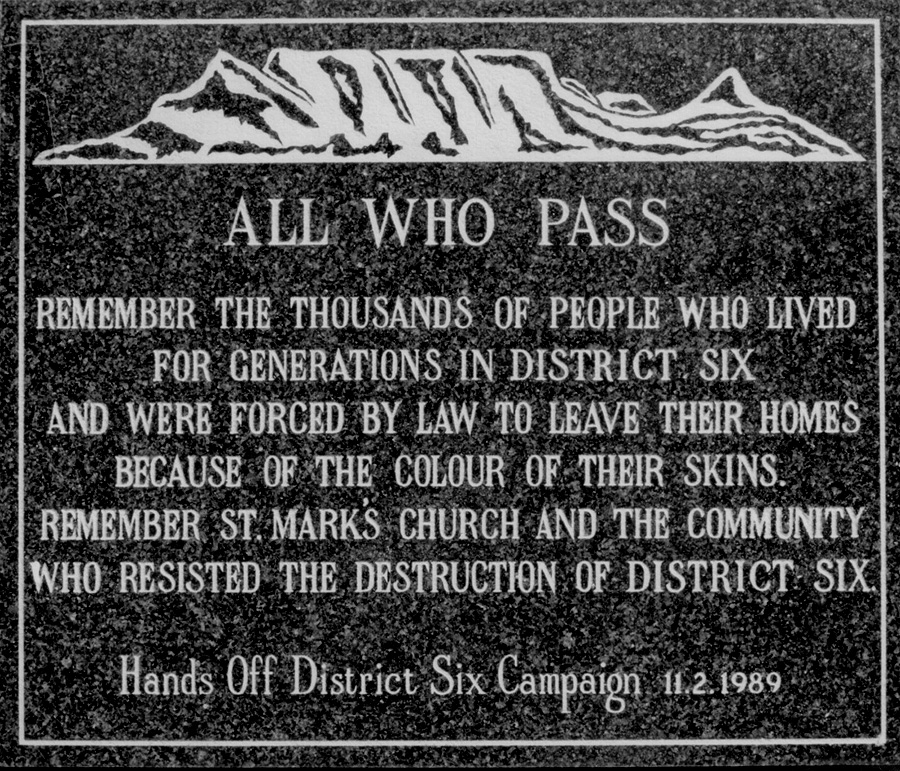
Memorial Plaque at the District Six Museum
https://upload.wikimedia.org/wikipedia/commons/1/1d/District-Six-Memory-Plaque.jpg


21 September 2015

Stories that will never be demolished

Rows of street names in front of wall-hangings recording
memoriesof the vibrant community which once was District Six
I'm not sure how museums will survive the digital age but I can't imagine that viewing images on a screen will evoke the same emotions that I experience whenever I step into the District Six Museum. For me, it's like settling into an old, comfortable chair and turning the pages of the family photo album and setting off a chain of memories. Perhaps it's the familiarity of the area - situated opposite the Sacks Futeran Building where I remember going with my parents to buy clothes and fabric, around the corner from the Grand Parade and the Castle. Of course, it's also across the road from the Caledon Police Station where many of us got arrested in the "old days". 

The Caledon Police Station
Maybe it's the energy which has seeped into the walls of the former Methodist Church which reminds me of the chapel on the hill in the old Zonnebloem complex, where my brothers and I went to school, me in my green dress with white collar and Panama hat, them in their grey shorts and white shirts. Whatever it is, I love going back and this morning an overseas visitor provided an excuse to for another visit. However painful the memories of living during apartheid may be, the exhibition at the museum humanises the experiences while celebrating the rich diversity of people who once lived in the area. 


When I see the barber's corner, the display case with the games we played in the road, the photographs of the Peninsula Maternity Home where my sister was born, the familiar recipes on the wall, or the wall-hanging with the name of the rugby team my father played for, I feel that our lives mattered. Most of all though, when I walk up the stairs to the wall that bears the names of families who lived there and I scroll down to find mine, I feel that our experiences have been validated and dignified.


As the byline on the museum brochure says: 60 000 stories that will never be demolished.

You may also like: 
Healing Memories of District Six


29 May 2015

The Slave Route Challenge


The Slave Lodge built in 1679 to house slaves owned by
the Dutch East India Company
With all the walking I did in the last year, I could have been in Johannesburg. However, I do think that beating the pavements around the neighborhood is what kept me sane and doing longer distances did come with a small sense of achievement. When Penny, my walking mate, posted the advert below on our WhatsApp group, it was the words 'Slave Route' which were most appealing though. And there was a 10km route.


slave route 2015 - advert 2


"But it's Mothers' Day," was one response from the group. What better way to spend the morning, doing something we enjoyed and the proceeds were going to Red Cross Hospital? So we signed up, not put off by comments like, "That's a tough one!" I did wonder what we were letting ourselves in for when I heard about "Koeksister Hill". And no snide comments from those of you who have run the WHOLE Two Oceans nine times! The race was fun, the weather perfect, the marshalls the friendliest I have encountered and the koeksisters on top of  the hill the best I have ever eaten (perhaps all the more so for the steepness of the hill!). 


            Waiting for the start in
          Darling Street
The hill 


Spectators along the way

The route took in familiar landmarks like The Company Gardens, District Six and The Castle of Good Hope to finish on the Grand Parade. Perhaps less well-known was the Slave Monument on Church Square, outside Die Groote Kerk and across the road from the Slave Lodge. 


Granite blocks on Church Square
bear names of slaves 

The Slave Tree once stood here
The race is an innovative way to introduce participants to the legacy of slavery in our city. Participants also received free entry to the District Six Museum and the Castle. Millions of South Africans are descended from slaves brought here by the Dutch from the east coast of Africa, India, Indonesia and other Indian Ocean islands in the 17th Century. These slaves and their descendants built our city and played a major role in shaping the identity of Cape Town. Because of apartheid, we were  taught to view this history through a lens of shame. It's time to reclaim our heritage with pride. 

Some further reading: 
Eyes of the Sky and The Slave Book both by Rayda Jacobs
Khalil's Journey by Ashraf Kagee
Echoes of Slavery by Jackie Loos

You may also enjoy: Walking through History: Celebrating our Heritage 

04 July 2012

Healing Memories of District Six


“The first time I took your mother out on a date we went to the Avalon bioscope, to the 4.00pm show to see “Trapeze” with Burt Lancaster, Tony Curtis and Gina Lollabrigida. Your mother was only allowed to go to the afternoon show. It was 1958. Chut Frieslaar was the manager of the bioscope.” The words poured out of my father’s mouth as we sat down to tea. We had just been to the District Six Museum and clearly many memories had been stirred.

My dad is a man of few words but as we walked around, he became more and more animated as he recognised people and places – the barber shop where he had his hair cut, his old school and his standard five teacher, and the public wash house. “You could find anything you wanted in Hanover Street, except petrol,” he said. “There was no garage, but everything else was there.”

On one of the walls was a recipe for “oumens onder die kombers” (which literally means old person under the blanket), which my grandmother used to make.  It is a traditional cabbage and meatball recipe – the cabbage is wrapped around the meatball, like a blanket. Alongside were recipes for other dishes from my childhood - tomato bredie (a lamb and tomato stew), bobotie (a spicy meatloaf) and skaapkop (sheep’s head).

I walked around with my book and pen on hand. I had wanted to capture these memories for a while now.  My dad had grown up in District Six and my grandmother had lived there well into the 70s. So we spent much time in Hanover Street – the house doctor, the barber, my uncle’s tailor shop, and the restaurant which sold the best samoosas and curry and roti, were all there.

It was almost as much of a journey for me as it was for him and I feel so blessed to have had the benefit of some of the stories. Before we left, my dad proudly signed the ex-residents’ book.