Showing posts with label culture. Show all posts

20 February 2017

On race and culture

I am still processing the information that, somewhere out there are 2000 people who bought a book with the good intentions of navigating the diverse cultures of the people of South Africa.  Instead, I shudder to think, they were offered stereotypes of so-called ‘coloured culture. That someone could be bold enough to write a chapter on the subject is wrong on so many levels. Where shall I start?

Firstly, the very notion of a grouping of coloured people is an artificial construct of an apartheid government hell-bent on denying the rights and freedoms to 80% of the population of our country, for more than 40 years. 

Secondly, culture, “the arts, customs, and institutions of a nation, people or group”, by its nature refers to a fairly homogenous group of people to begin with. There is no white culture or black culture or coloured culture.

Gabeba Baderoon in her book, Regarding Muslims, notes that,

… in the racial hierarchy of apartheid, ‘colouredness’ formed the interstitial zone between ‘native’ and ‘white’… defined solely through negatives, imbued with ambiguity … ‘colouredness’ was the fluid middle of the hierarchy in South Africa …

Even the architects of apartheid had trouble deciding who fitted into this group of “leftovers” (as Marike de Klerk so famously referred to coloureds). The fluidity that Baderoon refers to was evident in the seven subgroups of coloured made provision for in the Population Registration Act of 1950:

Cape Coloured/Malay/Griqua/Chinese/Indian/Other Asian/Other Coloured

And as Mrs de Klerk observed, the people who were” left after the nations were sorted out, the negative group, the non-people” were classified coloured.  Conveniently forgotten was the rich diversity of people descended from Indonesian slaves, Europeans, Khoikhoi and San, with diverse art, music, customs, speaking Afrikaans and/or English.  Also ignored by Mrs de Klerk and others like her, were studies that showed that on average 7% of all Afrikaner forefathers were of “coloured” origin. 

The Act required every citizen to be registered according to his/her race group, with race determined by a classification board acting on information from family and friends; a person’s hair, eyeballs and cuticles could be examined for pigmentation if there was any doubt. This fluidity meant, for example, that my grandfather could change his classification from ‘white’ to marry my ‘coloured’ grandmother, even though she was fairer-skinned than he. My aunt, who married a "real" European (as in he really was born there and not as a synonym for "white South African") was not able to live in South Africa with her husband. When she visited with her children, she was not allowed to stay in her mother’s “coloured” home with her “white” children.
My aunt Hilda on her wedding day

Lastly, tough as it may be to comprehend, there is only one human race. We are 99% genetically identical. There is no coloured race, or white or black race for that matter. So let’s refrain from deepening divisions by assigning sweeping characteristics to artificial groups of people. 

10 February 2016

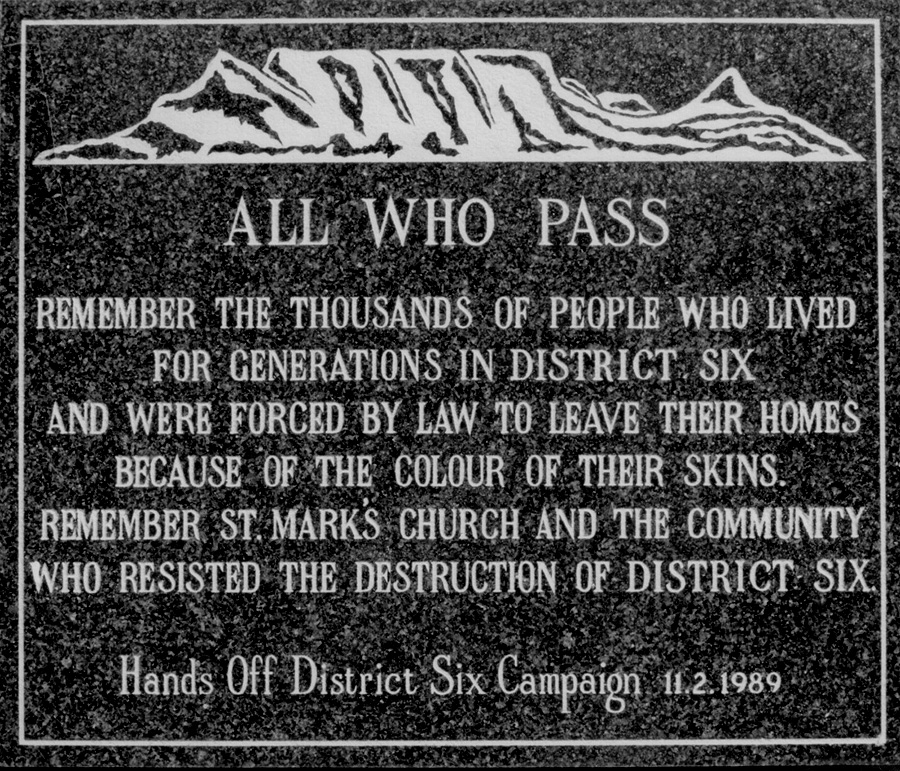
District Six - We will Remember


Family and Friends Woodstock/District Six circa 1940s
My grandmother holding my mother on the right
Thursday 11 February 2016 marks the 50th anniversary of the declaration of District Six as an area for Whites only. District Six is now unrecognisable from what it was before its destruction but I have fond memories of the area where my grandparents lived and my father was born.

My father in his rugby-playing days circa 1950
One hundred years ago there was a vibrant community there of Indians, coloureds, Portuguese, Greeks and Jews. Freed slaves, merchants, immigrants, artisans and labourers all worked and lived peacefully side by side. They were an eclectic mix of cultures, religions and ethnicities in a melting pot typical of a port city like Cape Town … apparently a threat to the apartheid government. It would take about 15 years to move the 60 000 people out, to the Cape Flats, to areas like Manenberg, Hanover Park and Mitchell’s Plain.

My life revolved around Hanover Street, the main artery which ran all the way up from the city centre, into Walmer Estate where I grew up.  My grandfather’s tailor shop, later to be taken over by my uncle, was a hive of activity there; the doctor who delivered me in my grandparents’ home, had his surgery there where we would queue for hours to be seen, and Majiet’s barbershop was filled with people not necessarily having their hair cut, but playing dominoes and catching up on the news. A trip into town would inevitably involve a stop for roti and curry from the Crescent Café. My father says that you could buy anything in Hanover Street except petrol.

Central to the area was the spirit of kanala – a Malay word for “if you please”. Before it became District Six , the area was called Kanaladorp, a mixture of Malay and Dutch, referring to the way people assisted each other, or did favours for each other – a version of Ubuntu.

Malay choir
photo courtesy Ismail Lagardien
Tied up with my memories is the music which was played in the streets by minstrels, Malay choirs and Christmas bands, and the food with names like bredie, bobotie, denningvleis, frikkadels and oumens onder die kombers. One dish that, for me, represents the Cape with Malay, Dutch and Christian influences blended together with fragrant spices was pickled fish. I remember my maternal grandmother making it in the last week of Lent, to eat on Good Friday. She would make it well in advance to give the spices a chance to penetrate the fish, and also to free up her Friday when she would spend many hours in church. The best fish to use was geelbek, kabeljou or yellow tail which would have been bought either from the fish market on the corner of Hanover and Clifton Street, opposite the Star bioscope, or from the fish cart which did the rounds in the neighbourhood. The hawker would sound his horn to alert housewives that he had arrived with the catch of the day and they would come out to the street to haggle.

Weddings were communal affairs
Weddings and funerals were community affairs. When I was about six or seven I was a flower girl twice in the same year, once for my aunt, a Christian wedding and then for a Muslim neighbour, a dressmaker who sewed all the dresses for the wedding herself. The whole street turned out to see the bride when the wedding cars hooted to announce her arrival, and the neighbours followed behind to the reception in the Princess Street Hall. Funerals were another occasion when everyone would just turn up to pay their respects and support the family in any way they could. Christian men would borrow fezzes and take their turns carrying the bier of their Muslim neighbours. 

As the bulldozers moved in and the walls came tumbling around her, my paternal grandmother was banished to Mitchells Plain, far from the city centre where she had lived her whole life. She had been a fiercely independent woman, who had to earn a living after her husband died and left her to raise four children on her own. She made koeksisters and konfyt to sell door-to-door on Sunday mornings in District Six, and sewed and crocheted. She used public transport or walked wherever she had to go. What I remember most was her loss of independence. Suddenly she found herself in a foreign area without any infrastructure and no public transport to fetch her pension from the General Post Office in Cape Town. For the first time she had to ask for help.

My grandaunt and friend snapped by street
photographer while walking past the GPO
Central to my motivation for going back to university, was to equip myself with skills to tell the stories of growing up, not only my stories but the stories of those who cannot tell their own. We’re a deeply divided society, still trying to recover from a brutal past. We cannot sweep it under the carpet, sooner or later the bump will trip us up. When you strip away a people’s history you take away their pride. Telling these stories helps to restore dignity and help us to move forward. We need to know that someone sees our pain and understands.

Wall in District 6 Museum bearing names of former residents

I urge you to visit the District Six Museum. However painful the memories of apartheid may be, the exhibition there humanises the experiences while celebrating the rich diversity of people who once lived here. For me, it’s like settling into an old armchair and turning the pages of a well-worn family photo album. When I see the barber’s corner, the display case with the games we once played in the road, the photographs of the Peninsula Maternity Home where my sister was born or the wall-hanging with the name of the rugby club my father played for, I feel that our lives mattered. And when I walk up the stairs to the wall that bears the names of families who lived here, and I scroll down to find mine, I feel that our experiences have been validated and dignified. 


Memorial Plaque at the District Six Museum
https://upload.wikimedia.org/wikipedia/commons/1/1d/District-Six-Memory-Plaque.jpg


24 June 2015


I am off to the USA next week. It's been eight years since my last visit and I am looking forward to catching up. I thought I would share some impressions from our last visit (2007) with my children, aged 14 and 10.

As soon as we stepped out of the taxi-cab, we were assailed by neon lights and sky-high billboards screaming for attention from entire sides of buildings. Electronic adverts for Foot Locker, Swatch, Virgin Mobile and Lucky Brand jeans, flickered in competition with announcements for Dancing with the Stars, Ultimate Fighting Championships and Stomp.

Towers of glass and concrete intersected at multi-lane crossroads of streaming yellow taxis, thick crowds of humans, blinding lights and the noise of a city on the go. I was reminded of how cosmopolitan the people in New York were. They appeared to have come from all over the world, each with a different dream. They were quirky with wild hairstyles, coiffed and business-like, strange, daring, downright weird, designer-heeled, sneaker-wearing, grey and colourful. No wonder people were prompted to do anything to be noticed, like don cowboy boots and a hat to play guitar naked in the traffic.

On our first trip with my daughter 13 years earlier, we’d been on our way down Fifth Ave, when we noticed a crowd gathering on the sidewalk, at the traffic lights opposite Van Cleef and Arpels. The large woman’s loud yellow shirt and gaudy floral tights were enough to cause a stir but it took me a few moments to realise that it was the python she had draped around her shoulders which was gathering attention.

New Yorkers, with mobiles glued to the sides of their faces, briefcases in hand, strode purposefully along sidewalks or streamed across the road, in obeisance to the flashing “Walk-Don’t Walk” signals. I recalled how curious a similar sight of businessmen accessorised with mobile phones had been on our visit in 1994. Two cell phone network providers, Vodacom and MTN, had only just been granted licences to operate in South Africa. We were a long way off from embracing cell phone technology and it seemed strange to me then that it could be such an indispensable part of American lives.

"This is just like in the movies,” my daughter remarked, as she slowly turned around on the sidewalk to take in the familiar sights. America was in our living room every day. This was where movies were made. She knew what Americans looked like, how they talked, hailed taxis, ate, ordered coffee, and fell in love. She thought all telephone calls started with “area code 555” and recognised the sound of police sirens. I’d fought to limit their exposure to television and find the balance with reading and outdoor activities, and yet she could rattle off names and intimate details of a string of actors. I joked that if her school work could be made into a movie, she'd be top of her class.  


The extract above is from my MA thesis.
Image by Gail Lindgren from http://www.freeimages.com/


22 December 2013

Wedding Season Part 2

It seems that the 20-second wrap-pleat-tuck-and-drape sequence that looked so effortless in the shop must come with a lifetime of practice. They had offered to sew in the pleats for me, but that sounded like it would be taking away from the authenticity of the experience. The offer of sending someone to the hotel to dress me, also sounded a little too indulgent. Imagine braving the Delhi traffic for a 20-second duty.

Well, getting into the sari in my hotel room was a rather more complicated process than I thought. The person, who housekeeping sent up after my frantic call, was as flummoxed by the slippery, heavily-embroidered material, in spite of being dressed in a sari herself. Hers, part of the uniform, was a much simpler, lighter affair but she confessed that she arrived at work an hour earlier to dress. Half an hour, some compromise and many safety pins later, I reasonably resembled the real thing.  I decided to leave my camera behind at the hotel, unsure of how I would manage taking photographs while trying to negotiate my way around without stepping onto my sari and coming undone.

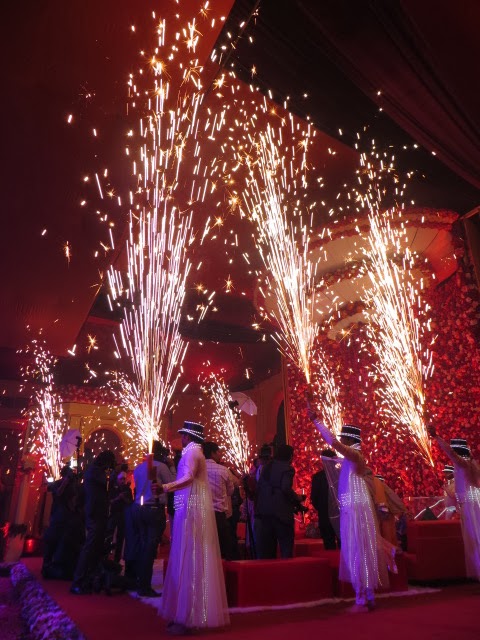
My daughter, who was dressed in a sort of Indo-Western fashion, didn't have the same navigation concerns and could wield her camera more easily. Our first function was the Sangeet, attended by about 2 000 guests. I alternated between gawking at all the beautiful people around me and at the decorations. Flowers adorned every surface, competing for attention with colourful chandeliers hanging from the ceilings. There was enough lights, music and dancers with bare midriffs for a Bollywood movie set. It took us at least an hour to distinguish the bride and groom amongst all the other leading stars gathered around.


In spite of all the glitz and glamour, the evening was relaxed and friendly and we made many new friends who had also been wandering around gawking, to keep us company over the following few days of celebration. At the end of the evening, heaving a sigh of relief that I had not unravelled, I leaned over sideways and flopped into the back of the car...not quite as Grace Kelly would have done it. 

01 July 2013

It's a small world, after all

I found myself thousands of kilometres from  Cape Town having a conversation with a Swedish woman in traditional Midsummer dress, and the UAE ambassador to Sweden, about Nigerian writer, Chimamanda Adichie’s book, Half of a Yellow Sun, which we had all read and enjoyed.

My son and I have spent four days in a small town in Sweden attending the Tallberg Forum. Tallberg is situated on the edge of Lake Siljan, a three-and-a-half-hour train ride to the north of Stockholm.  It has 230-240 permanent residents and eight hotels, all of which started out as farmhouses. The green hills surrounding the water, and long days of sunshine far from the bustle of the city, are conducive to interaction, reflection and absorption.
Every year since 1981 the Forum has been convened around the theme “How on earth can we live together?” It was established to provide a platform for free and open exchange of ideas and experiences. Participants come from all walks of life, from over 70 different countries. The people who attend are committed to finding solutions to improve the state of the world and are involved in businesses or NGOs which support that commitment. 


This year the focus was on globalization and how it relates to education, technology, culture, religion, race and identity. Huge problems exist globally around issues of the environment, education, health and human rights. I was struck by how South Africa is a microcosm of the concerns around the world.  

Our society is still so deeply divided and we are suspicious of those from whom we have been separated by apartheid. Before we can interact with the rest of the world, we need to learn to interact with the people who we live side by side with. We need to take time to get to know our neighbours, the people we go to school or university with, and the people we work with. We need to create an environment that invites sharing; a sense of community on a local and national level before we can truly be part of and participate on a global platform. Stereotypes and prejudices exist because we don’t take the trouble to move out of our comfort zones to get to know each other.

There’s hard work still to be done, necessary if we want to move forward. While we may not all agree on the issues, it is important to start talking. We may find that we are not all that different after all.


03 June 2013

Celebrating Africa


This year Africa Day arrived with a renewed sense of pride and hope for me. I have been immersed in two electives - African Non-fiction Literature and Public Culture. African literature focused mainly on South African books post-1994 and in many ways it was a gift of history far removed from the history that I had been taught at school in the 1970s. While it was painful to plough through the accounts of the Truth and Reconciliation Commission, I was enlightened by the behind-the-scenes revelations of the negotiation process and the run up to the first democratic elections. I was entertained and motivated by stories of growing up in Kenya and Katlehong –  stories which give life to communities, breaking down stereotypes and mass-labelling of people to fit into neat little boxes.  And I will look at Johannesburg with new eyes after reading Portrait with Keys, the tribute by Ivan Vladislavic.
It was Noni Jabavu’s books, published in the early 1960s, which were a special treasure though. They are a portrait of black life at a time when Verwoerd was introducing his draconian laws.  She provides an insight into the traditions, tribal customs and family life from a personal point of view. She straddled two opposing worlds – her roots in the Eastern Cape of South Africa, and her life in England, where she had been sent as a child.  She shows how we can use writing to correct the perceptions of the past, to record the voices of the past and to help preserve the traditions which, in SA, the government attempted to wipe out. I was very fortunate to find both her books at Clarke's in Long Street. This bookshop, established in 1956, is worth a visit if you're looking for South African and African books.

The Public Culture course looked at curating positive images of Africa and South Africa, to challenge the colonial stereotypes which abound. We focused on visual images along the theme of play and were exposed to photographers, archives and exhibitions, both past and present. I had the opportunity to look at the notion of music as a tool of resistance, at how it played a role in uniting and strengthening the community and how it flourished and developed in spite of oppression. 

I was struck anew at how jazz can be seen as a metaphor for the melting pot which is South Africa. It has a truly South African identity shaped by many influences - music of the African people, the Malays who were brought here by the Dutch, the slaves who were part of orchestras on the farms; visiting minstrels from the US which set the scene for the still-popular coon carnival, the  rich choral traditions and so on. It seems ridiculous now that there were laws governing details like whether black and white musicians could play together on a stage or perform to a mixed audience.
 We have developed a rich culture of music, writing and art, and people with spirit and values. What is often overlooked is what African people are doing to help themselves, rather than sitting back and waiting for others to come and solve our problems. Yes, there are starving children and disease, much suffering and oppression in Africa, but this is not the only narrative.

08 September 2012

Michelangelo's David - Withstanding Time

Photos of Statue of David, Florence
On this day in 1504 the statue of David by Michelangelo was unveiled outside the Palazzo della Signoria in Firenze. The statue was originally supposed to be one of many which would adorn buttresses of the Duomo. However, it was not deemed fit for the original commission and it stood outside the Palazzo for hundreds of years, withstanding time and the elements before being moved into the Galleria Accademia.

The David is splendid, as we experienced on a recent trip to Italy.  It's an unusual statue, because the boy is depicted in the moments before he attacked Goliath.  Most statues at the time showed the moments after David had cut off Goliath’s head. Of course we have to remember that any art is merely the artist’s impression. The David of the Bible was a young boy and could not have been quite so god-like in physique. Michelangelo was certainly showing off his knowledge of anatomy.

It was rather disconcerting to discover that the statue is slowly leaning over as a result of the erosion. Movement detectors have been employed to monitor any shift in the statue and plans are afoot to counter any damage. All those years standing outside have taken their toll, but isn't it amazing that something which was created hundreds of years ago is now being rescued by modern technology?

No photographs are allowed inside. “But if you want, you can take a picture of the pink David in the courtyard,” our guide informed us. There was a concurrent exhibition of modern art at the gallery and the garish pink David with yellow hair (including his pubic hair) and blue eyes must be making Michelangelo roll over in his grave. I couldn't bring myself to take a picture.  This photo of Statue of David is courtesy of TripAdvisor.

You can read more about this in today’s edition of the Writers’ Almanac:


27 June 2012

Clued up on Culture


Yesterday I went shopping for a gift for visitors from the Middle East. I hadn’t met them before, although my husband had. I wanted to buy something meaningful – which is difficult when he was as scant with information as he usually is in situations like these and had no helpful suggestions.

I rejected neutral gifts like scarves/shawls (coals to Newcastle and all that). Foodstuff wouldn’t do and you don’t buy perfume for anyone else unless you know what they like. Something South African would be great, so I dashed off to the Carrol Boyes shop at the nearby mall. 

While looking at the beautifully displayed pewter and stainless steel artworks on the shelves I remembered, in time, that I couldn’t be buying anything with the human form or figures, especially not naked, for fear of offending religious and cultural customs and beliefs. Eventually I settled on items which were not too big to transport, which I trusted would not offend and which would convey the feelings of welcome and friendship we wished to. 

In the Middle Eastern countries like Qatar or Saudi Arabia there is a process of doing business. You do business with people you know and trust. There is a ritual of exchanging gifts, sharing meals and getting to know each other, that cannot be hurried.

After negotiating this task, I remembered a valuable little book I bought a few years ago. It is called “Clued up on Culture” and is a guide about religious and cultural observance in South Africa, aiming to raise awareness about the diversity of the different people who make up our still new democracy. The primary function of the book is to advise the reader on what to do and say when confronted with the life stages of traditional Africans, Hindus, Christians, Muslims and Jews.

As Barney Pityana, of the SA Human Rights Commission says in the foreword: “It helps...to be conscious of the richness and glorious diversity that is a gift to our country...as a result...understanding and tolerance are promoted."

If you have ever wondered whether to send flowers when a Muslim colleague loses a family member or whether you should remove your shoes when entering a Hindu home or what to wear to a traditional African wedding, this concise handbook is a worthwhile investment.

Clued up on Culture by Barbara Elion and Mercia Strieman is published by Juta Gariep Publishing Company (Pty) Ltd

06 April 2012

Material - changing generations

Last week we went on a rare family outing to the movies – it’s not very cool to go with your parents but luckily my kids can still be persuaded, every now and then. This occasion was the much talked about local movie, Material starring Riaad Moosa. Moosa is a doctor-turned-comedian who feels a bit like family, since we know who his parents are and where he comes from.  We are proud that he is doing well, although he must raise some eyebrows in the community – “wasting” his medical education to be on the stage – which is why the story was even more noteworthy.

The story of a young Indian Muslim man breaking away from tradition to do something which is so foreign to his father and what he believes in is one that spans many cultures and generations.  The story is a familiar one:  Cassiem Kaif is expected to take over the family business (working in his father’s material shop) but wants to perform in a comedy club (something he enjoys doing and would like the opportunity to explore).

We all want our children to have what we didn’t (like education and opportunity) and so they inevitably turn out differently from the way we did. Then follows the need to reconcile our views with the way they see things. It’s less about holding rigidly onto our principles and more about allowing change and growth. The movie certainly struck a chord with me, having  two children who are growing up worlds apart from the way I did.

It’s a warm-hearted movie from the meditative images of men walking to mosque and preparing for early morning prayers right through to the resolution of a family feud and the happy ending. There was enough humour and drama in it to satisfy all of us. See it.

Material is a Ster Kinekor release and is still on the circuit. 

28 January 2012

Tea with Madiba

“Let the beautiful ladies step forward,” he says as we quietly enter the room behind my husband. It breaks the ice a little. I had been so looking forward to this but too scared to jinx it by getting excited or even telling too many people. Right up to the last minute I had thought it was not going to happen. What if he wasn’t feeling well? One hears so many different stories. But yes, we were being ushered in to see Madiba, and my daughter and I were the beautiful ladies he was talking about.

There he was, the most famous grandpa in the world. He was having a good day and was happy to receive visitors. He was sitting up with a blanket around his knees, catching up with the newspapers. (Was that the Afrikaans newspaper I spied on his lap?)

We had travelled through green countryside under rainy skies past villages with vegetable patches and goats and sheep outside their little thatched huts. It was like we were travelling back in time. We had passed through busy towns like Butterworth, where people snaked around the corner waiting to withdraw their hard-earned money from the cash machines for Christmas. And then for the best Christmas present ever...tea with Madiba.

What a journey from Mvezo/Qunu to Johannesburg, to Robben Island and the world, from herd boy to President.  And now back in Qunu. Last year after being very sick he decided that it was time to go home. Home is Qunu, the village in the Eastern Cape where he grew up, right next door to Mvezo the very rural village where he was born. It’s a peaceful place, and after almost 93 years, he deserves it.

I was a little sad to see him so “old”. In my mind he is eternal, like a shining beacon to all of us, and to the world. But right next door is a little baby who long after Madiba is gone will be chief of the Thembu. When Madiba plays with him as he does every day he must think of the future and delight in the possibilities.

Everyone wants to know what it was like, what he said – but it was more about just being there. It was like sitting down with our grandpa who was worried about why it was taking so long for us to be served our tea and whether the table was close enough to my husband, and smiling to himself when he saw how much my son had grown since the last time he had seen him. And he is still very charming...

08 December 2011

A Mezcla of a Wedding

Last week I attended a real mezcla of a wedding. In Spanish mezcla means a blend, a mixture or a medley. Spanish, Jewish, Catholic, South African and American cultures came together in what I like to think of as a new South Africa celebration. The bride, a friend’s daughter, is Jewish/South African/American, while the groom is Basque and Catholic.

A female rabbi, Dr Azila Reisenberger, was performing the ceremony and she took care to explain the meaning and origins of the different rituals that formed part of the union. The bride’s parents walked her down the aisle accompanied by a traditional Basque tune to the chuppah  or canopy under which the ceremony took place.

We had a little giggle when the rabbi asked the groom to identify his bride when the veil was lifted. This, the rabbi explained, has its origins in biblical times when Jacob, who was in love with Rachel, was tricked into marrying the wrong sister after working for their father for 7 years in lieu of a dowry!

The part of the ceremony that I loved was where each person in the retinue read out a blessing to the married couple and poured a little wine into a silver cup. By the time 8 people had done this, the “cup was running over” with blessings and it was given to the couple to drink from and share with their parents. Then it was time for a Jewish song and after the signing of the register, the groom’s sister played the flute while her father did a traditional Basque dance for the couple.

We followed the bridal party down through the vineyards (stopping to nibble on biltong and nuts) to the reception hall where a marimba band contributed the South African flavour.

Mazeltov! to these young people who have embraced the differences in each others’ cultures and traditions and at the same time enriched everyone at the wedding with the opportunity to be a part of a beautiful medley. 


14 July 2011

Cinnamon City


Morocco...Marrakech...Casablanca...the very words conjure up exotic smells of spices, visions of Arabian nights and belly dancers, mosaics, arched buildings and sounds of fountains tinkling in courtyards...Cinnamon City evoked all of that before I even opened the book. In fact I think that the cover of the book with its blue and white bowl of lemons set against a cinnamon-coloured sunset over a Middle Eastern skyscape is what attracted me in the first place. I was sold as soon as I opened the front cover to reveal the deep blue inside jacket.

The book is by Miranda Innes who seems to have a penchant for travelling to exotic places, buying property and living there. On a visit to a friend in Marrakech, she and her partner find themselves (unintentionally) buying up a riad with plans to convert it to a small hotel. 

What follows is an account of their adventure to restore the house to its former glory with the help of some very colourful local characters. In spite of going from one crisis to another, they fall under the spell of the city “where passionate music, magic potions and the drama of Africa are cooled by the intuitive genius of Arabic culture.”

I loved her descriptions of the challenges they encountered and the behind-the-scenes view of the old city. I could almost hear the calls of the muezzin. She has a gift with words that places the reader right there within the pink walls, in the mosaic-tiled courtyards and on rooftops, lolling about on cushions listening to haunting music. I could imagine searching for bargains in the souks - everything from jewellery to spices to leather goods, all business done over a glass of mint tea.

Look up Riad Maizie for more. It definitely looks like it should go on my to-do list. 

A very interesting fact that I learned, is that the world’s first university was started by a woman in 859 in Morocco – Al Qarawiyin by Fatima bint Mohammed ben Fehri.


Cinnamon City by Miranda Innes is published by Bantam Press.
Also, by the same author: Getting to Manana published by Transworld Publishers

22 June 2011

A Celebration of Music and Poetry

My son's school has for the past two days been buzzing with culture - music has been ringing out from different venues across the school campus, boys are walking about either on their way to compete, or to support their peers and external examiners are having a tough time awarding points. 

I popped in yesterday to listen to the boys perform in the Junior Woodwind Classical, Light and Jazz section and was very glad to be part of the creative energy that prevailed. They delivered pieces from composers as diverse as Scott Joplin and Franz Danzi

The Eisteddfod is in its 25th year at the school. The boys compete in  five sections - Speech, Performance, Visual Arts, Music and a group Singing competition (which is the culmination of the two days). The singing competition involves every boy in the school. What  a wonderful opportunity for young people to explore their creativity and to appreciate the talents of their peers. 

An "eisteddfod" is a celebration of music and poetry. It has its roots in Wales and goes back to the 12th century to a certain Lord Rhys who decided to have  gathering of musicians and poets from all over the country, at his castle. A chair at the Lord's table was awarded to the best poet and musician. Over time it became an annual event, alternating in North and South Wales - it lasts for about a week with people camping in tents on fields, dancing maidens and men dressed in flowing costumes and meetings around a circle of white stones that is the mark that an eisteddfod has taken place. 

17 February 2011

Celebrating the Ordinary

I feel like the camera has given me a new set of eyes. Suddenly I notice so many details in photographs and also have become more critical of elements like composition and lighting. The ordinary has become more photograph-able. Unfortunately, I don't always have the camera on hand.

Like, driving down the main road last week, I wished I could have stopped and taken a picture. There, filling the bus shelter, was a double mattress- and bed-set with two African mamas having a relaxing chat while they waited for the bus. One of them had even taken her shoes off. It reminded me of the time, a few years back, when we were doing some renovations in our previous house. The bathroom door we removed was not standard and we were not going to use it again. Mavis, who was our domestic worker at the time, jumped at the offer of a door for her house. "Don't worry," she assured us. "I bring someone on Saturday." Saturday Mavis arrived with a friend. I looked around in vain for the bakkie I had assumed they would be coming in. "No," Mavis replied to my query, "we take on train. She is going to help me with the door onto the train!" Now there would have been another good picture.

On another occasion, I pulled up at the robots next to an enclosed bakkie, at a busy suburban intersection. Eyes right, and right again! I didn't imagine the cheetah giving us what I hope was not a hungry eye! On closer inspection, I discovered it was the bakkie of the Spier rehabilitation centre for cheetahs. They had probably been to one of the schools in the area as part of the education program they offer. Only in Africa.

I am sure there is much material for many books on uniquely South African scenes. Here is one website I had discovered recently:

 http://www.photographersgalleryza.co.za/obie-oberholzer/

15 January 2011

Lavender, Travel Stamps and a Potjie: Part 3

Potjies on a fire in a village in the Eastern Cape 

Potjies are traditional cast-iron 3-legged pots which have been used to cook over a fire for centuries in South Africa. Usually a stew is made with whatever meat is available and vegetables and spices are added. Of attraction to me, is the fact that after initial preparation, it requires little looking after and you can socialize while it cooks for hours, stewing and blending all the different tastes. I like that you can throw a little bit of everything in and out comes something wonderfully harmonious. 

When I was deciding on the blog-header, the idea of a cultural melting pot to represent South Africa, came up. I thought it was quite appropriate to represent what I wanted to blog about and could also be a metaphor for my views on spirituality and religion, and indeed on life. 

When my son completed junior school at the end of last year, one of the traditions that he was involved in, was a Potjiekos Competition. There was great excitement as they were placed into groups and discussed recipes. He is a meat-and-potatoes man in the great South African tradition, of course, and we adapted his favourite meal - the Cape Malay tomato bredie. He was delighted that his team came in at third place. Here's the recipe that my mother used when we were growing up:

Tomato Bredie
Ingredients:
1 kg Mutton pieces (knuckles are great)
2 large onions
1 kg ripe red tomatoes (use canned if you have to)
1 tin of tomato paste
4-6 medium potatoes
2 cloves of garlic, crushed
2 teaspoons of sugar
salt to taste

Braise the onions until golden brown.
Add the meat and braise until soft.
Add tomatoes, tomato paste, garlic and cook for 15 minutes.
Add the potatoes and cook until soft.
Add the sugar to balance the tartness of the tomatoes.
Season to taste.

Best served with white rice.

(A vegetarian potjie is of course perfectly possible, too.)

For more on Potjiekos click here

So, these three blogs on potjiekos, lavender and travel, more or less explain the design of my blog-header, and a little about me. Hope you stick around for more.

For the two previous blogs, see here:
Lavender, Travel Stamps and a Potjie: Part 2
Lavender, Travel Stamps and a Potjie: Part 1

Lavender, Travel Stamps and a Potjie: Part 2

So although I have not yet visited the lavender fields of Provence, we have done quite a bit of travel. After a late start (I was 29 before I travelled outside SA for the first time) we have since travelled from Greenland to India, Cuba to Thailand, Canada to Egypt and a few more. We have immersed ourselves in cultures, preferring to get to know the locals, returning home richer for the experience.

Swedish bicycle

When my daughter was born it seemed like the most natural thing to carry on in spite of the prophets of doom who would have us believe that having children meant it was time to hang up the travel boots. She was nine months old when we took her to Mauritius and not quite three when she accompanied us on a 2-month long visit to India and Nepal. She travelled like a pro, charmed the locals and was the only one not to get sick. She was comfortable sleeping and eating anywhere although she did refuse to use any “squatting toilets”. The bladder strength she built has stood her in good stead for later travel.

Italian bicycle
By the time her brother was born we thought we had the travel thing down pat. He proved to be more of a challenge, though as he was more resistant to change and disruptions to his routine. Once we established that he needed rest days in between and that he needed to know exactly how many days we would be away and what we would be doing on those days, he was fine. It took until age seven though before he shocked us by asking if we could go back to Florence if we missed the plane home from Milan. Italy has remained a favourite.


Thai bicycle


We subscribe to Mark Twain’s assertion that travel is fatal to narrow-mindedness and bigotry. So we have only ourselves to blame that our daughter, aged 17, has not only spent two months in Toronto , Canada, on exchange but has also just returned from a remote, hill-tribe village in Thailand where she has been helping to build a water storage tank. In both countries she has immersed herself locally and though she has missed home, has had a ball of a time. Each time she returned, I noticed how she has grown up and become more independent. I have little doubt that she will fly the nest soon. And we are proud of having given her the wings. 

28 November 2010

Love across the Line

Last night my son and I rented the movie Our Family Wedding - a story about a cross-cultural wedding and the difficulties the bridal couple endure. I didn’t expect it to be a good movie (it wasn't) but was curious to see Ugly Betty’s America Ferreira and maybe have a bit of a laugh.

It was interesting to see the levels of racism portrayed in the movie. It's the same issues which have been highlighted in many movies like My Big Fat Greek Wedding, and many others which portray love across the “line”. But this movie was quite explicit about the differences between the families, and even the workmen were making fun of the wedding between "Mexicanos" and "Negritos". It's one thing when the two families hold onto their traditions so fiercely that life becomes difficult for the bridal couple but quite another when a whole community is against the wedding. I know it's hardly the definitive word on the state of racism in the US but I believe that it's a close reflection of reality. It's certainly an issue here in South Africa.

I have written about racism in a previous blog but it is a topic I will probably keep coming back to as I battle to make sense of where we come from. I believe that we are not born racist. But we have this instinct to hold onto what is familiar and to protect our traditions to a level where we exclude others. It is such a limiting standpoint. We close ourselves off to new experiences and viewpoints that can only enrich our lives.

I had a very interesting chat to a woman at dinner the other night – she is Swiss-German, her husband Italian and they are living here temporarily. For a while French was their common language until they had children and then decided that they should speak Italian. The children went on to be educated in the UK. The daughter married a Brazilian who she met while working on a project in India. They now live in Australia. The son who was living in the US, not to be outdone by his sister, has a partner of Japanese and American origin and they live in Spain. I think I got that all right!

I find the lack of borders and artificial boundaries wonderful. The family is truly international. They have travelled and worked in different countries and been exposed to diverse people and cultures. They have rich experiences and I am sure that there has to be tolerance and respect for it to work. I am rubbing my hands in glee waiting to see how the grandchildren turn out!

Like Mark Twain said, travel is fatal to bigotry, prejudice and narrow-mindedness. But we don’t need to go far. We can travel to our neighbours and communities, read, watch movies and be open to different experiences. It comes down to respecting each other, embracing differences and understanding that our way is not the only way.

26 November 2010

Dinner invite for one

I have been to three social functions on my own in the last ten days.  I am not sure how this has happened since I would normally choose to decline rather than go alone. My husband being away provides the perfect excuse. However, the Inyathelo Philanthropy Awards, held last week, is an annual function I enjoy going to, and, on Friday night, a close friend was hosting a charity table. So I did want to go, although that awkwardness of arriving and not seeing anyone that I knew, was evident on both occasions. 


This evening's function however, purely social, I sort of got talked into and before I knew it I received an email about how nice it would be to have me. As the week progressed I found myself making a hair appointment and thinking about what to wear, alternating with what am I letting myself in for? However, by yesterday I had decided to keep an open mind and go with the flow. If nothing else, I would have a story to tell. Last week I noted that "So, do you work?" has changed to "What industry are you in?" Although that conversation progressed pleasantly enough. It seems yoga has become rather popular recently.  


I love to people-watch, so actually going to a function is not all effort. Last night there was plenty to watch. Like the little Asian man who was wearing the brightest green jacket that I have ever seen -  as if he was trying his utmost to make up for his size and be noticed. There was also the unlikely blonde, surely surgically-enhanced, who when introduced to a tall Xhosa gentleman, let out a string of isi-Xhosa. It was delightful to see the connection it immediately made. He leaned in closer and a for a few moments spoke animatedly. The conversation continued in English but had been lit by the spark of that connection. It reminded me of a quote by Nelson Mandela, "If you talk to a man in a language he understands, that goes to his head. If you talk to him in his language, that goes to his heart."  Also another reminder not to put people into boxes!


Our hosts were a lovely couple who have raised truly international children - speaking six or seven languages between them and mixing as many cultures with their choice of partners! Their two children are now on opposite ends of the planet while they will be here for the next while.  


I sat next to a very charming gentleman from Portugal, who told me that if you needed to find your daughter a husband the best place to do so would be to send her to hotel school in Switzerland! Apparently there are many unions between hotel students. Not unlike medical school, which has the same phenomenon for many of the same reasons. When you work so hard and such odd hours, you need a partner who will understand what you are going through. 


The restaurant was casually elegant and the food good - not "child portions arranged by an interior designer", as one guest at the table observed.  Although I could have foregone all just for the most sublime chocolate dessert! I had a pleasant evening and met some interesting people. Sometimes you just need to go with the flow. Or maybe it doesn't matter so much anymore what people think.