02 September 2015

Orpheus in Africa

South Africa’s rich legacy of music can be traced back to the 17th century when the indigenous Khoi people first played European folk songs on a ramkie, the guitar-like Malay instrument, and fashioned their dances on those of the Dutch. Country estates had orchestras made up of slaves. In fact, music was a highly valued skill which could ensure a higher price for a slave. The Malays, who were brought to the Cape from the East Indies by the Dutch, blended their music with Dutch colonial ballads. Coloured labourers brought to work on the diamond mines in Kimberley combined their own music styles with that of Africans who they came into contact with. 

The Lutheran missions and the Salvation Army contributed to the development of African choral traditions, the most famous example of this heritage being Enoch Sontonga’s Nkosi Sikelel’ iAfrika which came to symbolise the struggle for African unity and liberation in SA. The fact that the missionaries offered free musical education was a major attraction. 

Another influence on local music was minstrelsy, which took hold after McAdoo’s American Jubilee Singers toured SA at the end of the 19th century. Their influence can still be seen in Cape Town’s annual coon carnival. But it was jazz that would influence and shape most black music, from mbaqanga, marabi (shebeen music) to the penny whistle or kwela craze.  Rather than simply copying American jazz, Ian Smith (musician and director of the Delft Big Band) believes that the Cape Town sound evolved from the minstrels, the slaves, and the Malay choirs. [extract from paper on music as resistance]

In his book In Township Tonight! David B, Coplan, paid tribute to the musicians and composers who contributed to the cultural and spiritual quality of black life during apartheid, giving expression to the their lives under apartheid. His book explores the history of music in SA from indigenous traditions, slave orchestras, gumboot dancers and minstrels to the birth of jazz. 

I missed it earlier this year, but David Kramer's Orpheus in Africa returns to the Fugard Theatre on 22 September. It tells the little-known story of Orpheus McAdoo, who toured South Africa in the late 19th century with his Jubilee Singers. It runs until 31 October but the first season was sold out so book early.

29 August 2015

Education to Change the World

A very recognisable quote as we rounded a corner in Boston


While in the USA, I visited a few of the 1 200+ schools* (see below). I was struck by two characteristics which I believe are common to the education system in America. One was the accessibility of the education and the other was the balance of the curriculum. 

For Americans who want to study, there are federal grants and bursaries and many of the universities, even those like Harvard, offer needs-based scholarships.  This means that if you have the academic ability, by and large, lack of funds need not be a stumbling block. This results in a diversity of students which I found exciting.

I was also very taken with the liberal arts core of the curriculum. Subjects like art, history, music and science, form the basis of an all-round foundation. In other words, graduates who are able to hold forth on a variety of topics, are being produced. Majors are only declared in third year. 


Education was the tool that the South African government used to oppress us…education was meant to keep us in our place. You were able to learn just enough for the jobs that you were expected to do; depending on the colour of your skin, you had enough education to become a factory worker, a maid or a gardener, or if you were lucky, a teacher or a nurse. 

My grandfather taught me that education was the one thing that the apartheid government couldn't take away from us; that they had taken away our rights, property and opportunities but they couldn’t take away what was in our brains, they couldn’t stop us from learning. I believe that it’s the same tool that was used to oppress us that must be used to uplift us. So many generations of people in our country haven’t had access to education. We’ve come a long way from where we were but we have to keep fighting so that our children, and our country, can have a better future. 

I know that the American school system is far from perfect, but I think that this kind of accessibility and well-rounded curriculum is something to strive for. 


*A four-year college or university offers a bachelor's degree. Programs that offer these degrees are called "undergraduate" schools. A "university" is a group of schools for studies after secondary school. At least one of these schools is a college where students receive a bachelor's degree

13 August 2015

Jacob Lawrence and the Migration Series

The migrants arrived in great numbers - Panel 40


"Having no Negro history  makes the Negro people feel inferior to the rest of the world...I didn't do it just as a historical thing., but because I believe these things tie up with the Negro today." 
Jacob Lawrence 1940

This quote sprang out at me from the wall of the Museum of Modern Art (MOMA). It is the reason that I need to start writing the stories of growing up in Cape Town during the 1960's and '70's. I was inspired by the simplicity of Lawrence's series of 60 paintings which records a significant era in American history.

One-Way Ticket: Jacob Lawrence's Migration Series and Other Visions of the Great Movement North is currently on at the MOMA as part of a programme exploring the legacy of the Great Migration and its impact on American culture. From 1915 to 1970, almost six million black people fled the rural South for northern and western cities in search of a better life, thereby indelibly altering the demographics of the USA.

Jacob Lawrence (1917-2000) grew up in Harlem, New York but both his parents had been part of the mass relocation from the impoverished South to the urban, industrialised cities. He was greatly influenced by the colour and vibrancy of the community in which he lived and set about recording the songs, stories and experiences of his parents' generation through his art. 

By the time he was 23 he had completed the paintings which make up the Migration series. In 1941, at the height of racial segregation in the country, he was the first African American to have his work exhibited at the MOMA. 

A long table with a row of tablets giving access to a multi-media website, occupied the centre of the exhibition room. It soon attracted a group of school children tasked with a summer project of choosing their favourite painting to write a poem about...21st century technology providing the bridge to history. 


This painting illustrates how effectively Lawrence has captured the loss and suffering brought about by the human rights abuses during this period of American history. It's what he has left out of the picture which is most striking. 

The exhibition is on until 7 September. 
View the Migration Series here 
Image from Migration Series from MoMa website, click here 

10 August 2015

A Walk in the Woods

"A path that vanished into a wood on the edge of town ...
A sign announced that this was no ordinary footpath but
the celebrated Appalachian Trail."

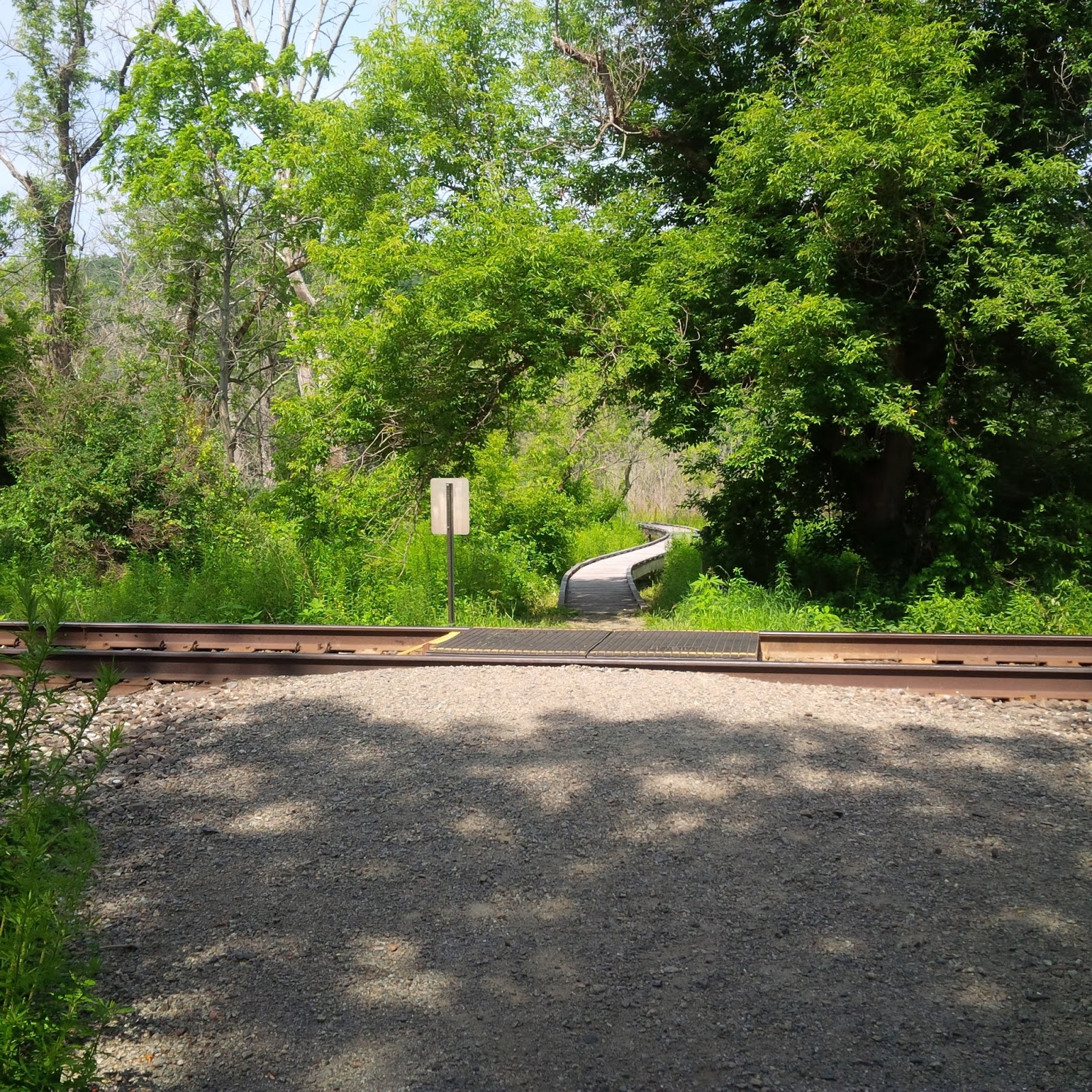
I had grand plans for reading Bill Bryson's A Walk in the Woods while in the USA and then actually walking a little of the trail in Maine. The plan to visit Maine didn't work out, so I was pleased to find that we could access the trail from where we staying on the New York-Connecticut border.


I'm a big Bryson fan, but for some reason, it proved easier to actually get out there and experience the trail than get into the book. I think that it was the moaning of his friend, Stephen Katz, which put me off, but then who am I to talk after only doing 1/300 of the 2 100 miles of the trail?

"The AT is the granddaddy of long hikes."

The Applachian Trail is the longest continuous footpath in the world, stretching along the east coast of the USA, from Georgia to Maine.


From Georgia ...
...to Maine

I did read enough to be warned about the merciless insects. The insect repellent was no match but, being from Africa and having observed many a zebra or antelope in the wild, we found that by swishing a small branch over alternating shoulders, we could stop the pests flying right into our mouths every time we tried to speak to each other. Perhaps it was a similar scenario which inspired those Australian hats with dangling corks. We could have done with one of those. 


It wasn't long before we reached the end of the woods and wandered along paths edged with metre-high grasses and rolling meadows. I repressed the urge to break out into song...we were already get odd looks from fellow-hikers when they saw our fly-swatters.


According to Bryson, every twenty minutes he and Katz did on the AT was further than the average American walks in a week. "For 93% of all trips outside the home, for whatever distance or whatever purpose, Americans get in a car." That may be true, but I did get in at least twice as much as walking as I would normally do at home and, like Katz, I can say " the only thing that matters ... is that I hiked the Appalachian Trail". 

Bill Bryson, A Walk in the Woods, is published by Transworld Publishers, UK

06 August 2015

Walking to Connecticut


It's been a while since I travelled to the USA, as mentioned in my last blog, and I'd forgotten about the effects of a six-hour time difference. It didn't take too long to settle in once we arrived at my friends' house in a village on the border of New York and Connecticut states, though. It helped that I could put on my tackies and walk across state lines...here are some photos of rural America taken on our many walks...


We arrived on the Independence Day weekend, so had the opportunity to soak up the American way at a barbecue, where teenage girls frolicked in the pool, impromptu games of soccer were played on the lawn and the noises of fireworks and college kids home for the summer were punctuated by the thwack of a baseball in a catcher's mitt. Desserts of peach cobbler, blueberry pie and other cakes dazzled with sprays of stars and stripes in red white and blue.


flags everywhere...even in the middle of a field
The jet lag was more of a killer coming back home, hence the delay in posting, but look out for more from "the greatest country in the world" (as overheard at the barbecue). 

24 June 2015


I am off to the USA next week. It's been eight years since my last visit and I am looking forward to catching up. I thought I would share some impressions from our last visit (2007) with my children, aged 14 and 10.

As soon as we stepped out of the taxi-cab, we were assailed by neon lights and sky-high billboards screaming for attention from entire sides of buildings. Electronic adverts for Foot Locker, Swatch, Virgin Mobile and Lucky Brand jeans, flickered in competition with announcements for Dancing with the Stars, Ultimate Fighting Championships and Stomp.

Towers of glass and concrete intersected at multi-lane crossroads of streaming yellow taxis, thick crowds of humans, blinding lights and the noise of a city on the go. I was reminded of how cosmopolitan the people in New York were. They appeared to have come from all over the world, each with a different dream. They were quirky with wild hairstyles, coiffed and business-like, strange, daring, downright weird, designer-heeled, sneaker-wearing, grey and colourful. No wonder people were prompted to do anything to be noticed, like don cowboy boots and a hat to play guitar naked in the traffic.

On our first trip with my daughter 13 years earlier, we’d been on our way down Fifth Ave, when we noticed a crowd gathering on the sidewalk, at the traffic lights opposite Van Cleef and Arpels. The large woman’s loud yellow shirt and gaudy floral tights were enough to cause a stir but it took me a few moments to realise that it was the python she had draped around her shoulders which was gathering attention.

New Yorkers, with mobiles glued to the sides of their faces, briefcases in hand, strode purposefully along sidewalks or streamed across the road, in obeisance to the flashing “Walk-Don’t Walk” signals. I recalled how curious a similar sight of businessmen accessorised with mobile phones had been on our visit in 1994. Two cell phone network providers, Vodacom and MTN, had only just been granted licences to operate in South Africa. We were a long way off from embracing cell phone technology and it seemed strange to me then that it could be such an indispensable part of American lives.

"This is just like in the movies,” my daughter remarked, as she slowly turned around on the sidewalk to take in the familiar sights. America was in our living room every day. This was where movies were made. She knew what Americans looked like, how they talked, hailed taxis, ate, ordered coffee, and fell in love. She thought all telephone calls started with “area code 555” and recognised the sound of police sirens. I’d fought to limit their exposure to television and find the balance with reading and outdoor activities, and yet she could rattle off names and intimate details of a string of actors. I joked that if her school work could be made into a movie, she'd be top of her class.  


The extract above is from my MA thesis.
Image by Gail Lindgren from http://www.freeimages.com/


21 June 2015

International Yoga Day


21 June has been declared International Yoga Day by the UN, with the support of South Africa and 176 other countries. I have been practicing yoga for more than half of my life and taught classes to children for a number of years. I have also volunteered at Project Playground but probably the most challenging was teaching yoga at a shelter for women and children. I learned much there...

Tucked away at the end of a cul-de-sac in a quiet suburb in Cape Town is an unremarkable house which offers shelter to abused women and children. There are no signs to tell you what place this is. It is a small organisation offering shelter to 28 persons. I used to run a weekly breathing and relaxation class. Usually there were about 6 women but this varied from week to week, depending on whether they had gone back home, found a job or moved on from the shelter. The amount of complaining and cursing that was done because they were so stiff makes me hesitate to call it a yoga session! 

For many of these women, this was the first time they had ever done any ‘exercise” and this, coupled with the fact that there was so much tension sitting in those bodies because of all they had been through,  made it unbelievably difficult to stretch. However, the relaxation session was eagerly awaited by all. It was often noisy in the shelter and the room we used was close to the kitchen but I think that it created a valuable opportunity to learn to practice these skills in all conditions. It was highly unlikely that they would have a quiet little studio somewhere!

The sessions started with basic asanas (postures) and incorporated breathing exercises. At least a third of the class was dedicated to guided relaxation to music. Different visualisation techniques and the contract-relax methods were used. 

I have made some interesting observations during the classes. One is the difficulty the women have with any asana that requires any “force” e.g. when doing cleansing breaths they are unable to force the air out of the body. It is as if they have learned to suppress thoughts, actions and emotions. They were generally very passive and seemed to wait to “receive” what I had to offer them each week.  I noticed that they did not even offer to assist with putting out mats and were generally not ready for the class even though they knew when I was coming. It was as if they needed to be “led” into the session.

I had wondered about the effectiveness of what I was doing, but one morning I overheard one of the women (who happened to be the most vocal complainer) explain to a newcomer how important this session had become in her week. She said that it was the only time that was solely hers, when she was not expected to give anything to anyone. 

I have learned to be patient and tolerant. I have learned that it is not what I can do to help but what they need from me that is important. I have learned that it is the process that is important and not necessarily the end-product. I have learned that sometimes the only way to do something is to go with the flow. I have learned to work with what is given to me and in the place that it is given. And I am trying to be as flexible in my mind and attitude as the yoga I do aims for.

The first principle of yoga is to do no harm and this applies to your own body as well as to others. Yoga teaches you to treat your body with compassion and to work within your own boundaries. Yoga is not a competition. You are asked to not compare yourself to anyone else in the classroom. Your focus is on what you can do on your mat. Yoga emphasises that what you are, where you are, is good enough for today.

And your body is the harp of your soul, and it is yours to bring forth sweet music from it, or confused sounds. Khalil Gibran 

You might also like: Becoming Humble: Lessons teaching yoga in a township hall
Photo of Melissa Brake of YogaWay Pilates and Yoga Studio taken by me